excl VAT

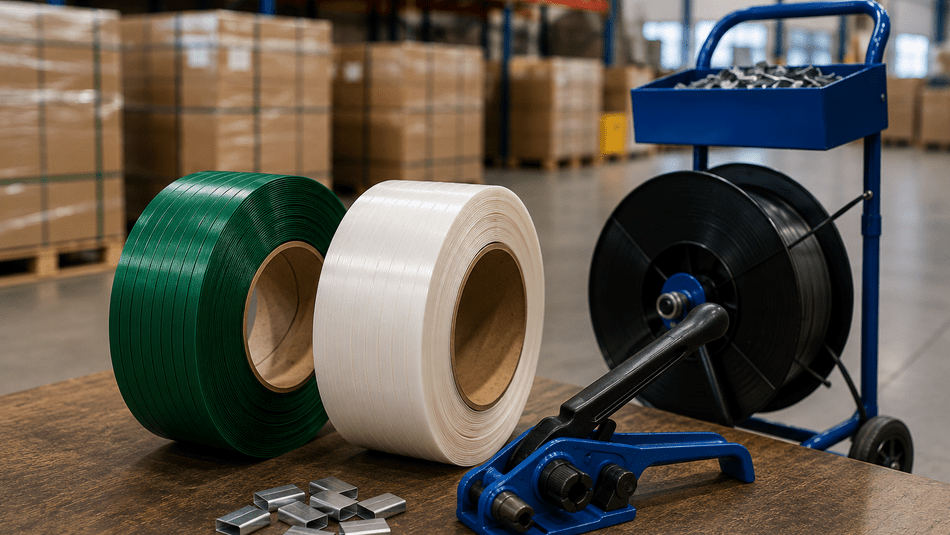
When choosing strapping for business use, one of the most common questions is: PP or PET? Both are used to secure boxes, shipments and palletised loads, but their properties, applications and most suitable use cases differ.
PP strapping is more commonly used for cardboard boxes, lighter and medium-weight loads and larger volumes of standard shipments. PET strapping offers higher tensile strength and better tension retention, making it more suitable for heavier loads and pallets.
At 8boxes.lt, you can find PP strapping, PET strapping, strapping materials and strapping machines and tools.
PP strapping is made from polypropylene. It is lightweight, flexible and economical, making it widely used for everyday packaging tasks.
PP strapping is especially suitable for:
PET strapping is made from polyester. It is stronger and retains tension better than PP strapping, making it more suitable for heavier loads and applications requiring more stable load securing.
PET strapping is commonly used for:
| Feature | PP strapping | PET strapping |
|---|---|---|
| Material | Polypropylene | Polyester |
| Best suited for | Light and medium loads | Medium and heavier loads |
| Tension retention | Moderate | Higher |
| Flexibility | Higher | Lower, more stable |
| Tensile strength | Lower | Higher |
| Cost | Usually lower | Usually higher |
| Box strapping | Very suitable | Possible, but often unnecessary |
| Pallet securing | Lighter loads | Very suitable |
| Automatic machines | Commonly used | Depends on the machine |
| Manual / battery-powered use | Yes | Yes |
PP strapping is generally more suitable when:
PET strapping is generally more suitable when:
For lower packaging volumes, a manual solution is often sufficient.
The 13–19 mm manual PP/PET strapping set is designed for manual strap tensioning and sealing. It is suitable for smaller packaging volumes where simplicity and lower initial investment are important.
For more frequent strapping work, a battery-powered PP/PET strapping tool can be a more efficient solution.
Such a tool:
Tightly tensioned PP or PET strapping can place pressure on load corners and damage them.
Plastic corner protectors help to:
If strapping is used regularly, a large roll is easier to handle with a dedicated dispenser or trolley.
The PTDP PP/PET strapping dispenser and the H500 PP/PET strapping trolley help to:
If you need an economical way to secure cardboard boxes, shipments or lighter loads, PP strapping is usually sufficient.
If you are securing heavier pallets or industrial loads and require greater and more stable tension, PET strapping is usually more suitable.
PP strapping – for boxes, shipments and lighter loads.
PET strapping – for pallets and heavier loads.
Before choosing strapping, consider:
One of the most common mistakes is choosing strapping based only on price.
Cheaper PP strapping is not necessarily more economical if a heavier load requires more material or if it does not provide sufficient stability. At the same time, there is little benefit in using stronger PET strapping for a lightweight cardboard box when PP strapping fully meets the packaging requirements.
Another common mistake is failing to check strap width compatibility with the tool. For example, a 12 mm PP strap is not suitable for a tool designed for 13–16 mm strapping.
That is why it is important to evaluate not only the strap itself, but the complete strapping system.
Depending on the packaging process, you may need PP strapping, PET strapping, strapping machines and tools, strapping materials and accessories and plastic corner protectors.
A properly matched strap, tool and accessories help improve working speed, achieve more consistent results and control packaging costs more effectively.
If you are unsure which PP or PET strapping is right for your application, contact 8boxes.lt. We can help assess the load type, packaging volume and operating requirements and recommend compatible strapping, tools and additional packaging accessories.