SEO title: Furniture Manufacturing Packaging Solutions | 8boxes.lt
Meta description: Packaging solutions for furniture manufacturing: stretch film, corner protectors, PP/PET strapping, boxes, protective materials and pallet preparation for transport.
Furniture Manufacturing Packaging Solutions
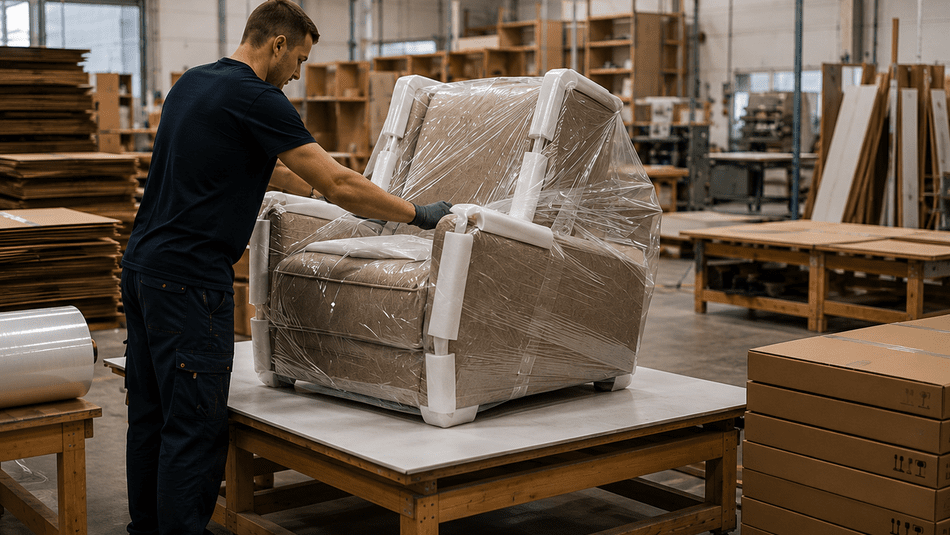
In furniture manufacturing, packaging has to protect not only the product itself but also its surfaces, corners, edges and individual components during storage and transport. Even minor surface damage can lead to additional repair, return or repacking costs.
Properly selected packaging materials and equipment help protect furniture from scratches, impacts and movement, stabilise loads and standardise the overall packaging process.
8boxes.lt offers packaging materials, stretch films, strapping materials, protective packaging materials and packaging equipment suitable for different stages of furniture manufacturing and logistics.
Furniture surface protection
Furniture surfaces are often sensitive to scratches, impact and abrasion.
This is especially relevant for:
- painted surfaces;
- laminated boards;
- solid wood;
- glass elements;
- polished surfaces;
- fittings;
- decorative components.
Protective packaging materials can be used to create an additional protective layer between surfaces and reduce the risk of direct contact damage.
It is important to choose materials that protect the surface without damaging it themselves.
Corner and edge protection
Furniture corners and edges are among the most vulnerable areas during transport.
Plastic corner protectors can help to:
- protect corners against direct impact;
- distribute PP or PET strap pressure;
- reduce the risk of surface deformation;
- keep strapping more stable on the load.
This is particularly relevant when packaging worktops, panels, cabinet components, doors and other larger furniture parts.
Stretch film for furniture packaging
Stretch film can be used to protect furniture and its components and to bundle several parts into one load.
It can help to:
- protect against dust and moisture;
- hold additional protective materials in place;
- bundle several components together;
- reduce component movement;
- stabilise goods on a pallet.
However, stretch film should not be used as the only protective layer on sensitive decorative surfaces if direct film contact could damage them.
In such cases, a suitable protective material should be applied first, with stretch film used as an outer securing layer.
Hand or machine stretch film?
For lower volumes and irregularly shaped furniture, hand stretch film is usually more convenient.
It is suitable for:
- individual furniture components;
- non-standard shaped products;
- lower production volumes;
- situations where the load cannot be placed conveniently on a pallet wrapper.
When furniture production regularly includes more consistent palletised loads, it may be worth considering machine stretch film together with a pallet wrapper.
PP or PET strapping for furniture packaging?
When furniture components or pallets need additional securing, PP and PET strapping can be used.
PP strapping can be suitable for:
- lighter furniture components;
- cardboard boxes;
- fitting kits;
- smaller loads.
PET strapping is more commonly used for:
- heavier furniture parts;
- panel bundles;
- larger pallets;
- loads requiring more stable tension during transport.
The right strap type should be selected not only according to load weight but also load shape, surface sensitivity, the tool being used and transport conditions.
Battery-powered strapping tool
If PP or PET strapping is used regularly in furniture manufacturing, manual strapping can become time-consuming and physically demanding.
A battery-powered PP/PET strapping tool can help to:
- tension the strap more quickly;
- weld the strap ends;
- achieve more consistent results;
- reduce physical workload;
- standardise repetitive strapping operations.
The strap width and tool specification must be compatible.
Packaging small parts and fittings
Furniture production often includes small components such as:
- fasteners;
- screws;
- hinges;
- handles;
- brackets;
- installation components;
- other small parts.
Packaging bags and films are convenient for grouping small items.
Zip-lock bags can help to:
- group fittings by set;
- reduce the risk of losing small components;
- make kit identification easier;
- keep installation parts organised with the main product.
Cardboard boxes for furniture components
Not all furniture products are shipped fully assembled.
Smaller components, fittings and separate parts can be packed in cardboard boxes.
Boxes are especially practical for:
- fitting kits;
- smaller components;
- accessories;
- fasteners;
- separate product parts.
When choosing a box, make sure there is not excessive empty space inside, or use suitable protective material to prevent movement.
Carton sealing solutions
When furniture manufacturers regularly pack fittings, components or other parts into cardboard boxes, carton sealing equipment can be worth considering.
It can help to:
- speed up box preparation;
- standardise sealing;
- control tape consumption;
- reduce manual handling.
The greatest benefit is usually achieved when similar-sized boxes are used in sufficiently high volumes.
Preparing furniture for pallet transport
Larger furniture components are often grouped on pallets.
In such cases, consider:
- load centre of gravity;
- component arrangement;
- contact between surfaces;
- corner protection;
- amount of stretch film;
- PP or PET strapping;
- possible load movement during transport.
A stable load should be created before wrapping or strapping begins.
Additional packaging materials cannot fully compensate for a poorly arranged load.
When is it worth using a pallet wrapper?
If similar palletised loads are prepared regularly at the end of production, a pallet wrapper can help to:
- standardise the wrapping process;
- reduce physical workload;
- control film tension more accurately;
- achieve more consistent results;
- use machine stretch film more efficiently.
For unstable or non-standard furniture loads, a standard turntable wrapper may not always be the best option, so actual load dimensions and stability should be evaluated before choosing equipment.
Product and package labelling
In furniture manufacturing, labelling is important not only for transport but also for order assembly and component matching.
Label printers can be used for:
- product codes;
- part numbers;
- set numbers;
- barcodes;
- order numbers;
- customer information;
- warehouse locations;
- installation sequence identification.
Clearly labelled components help reduce picking and assembly errors and can make both warehouse and installation processes more efficient.
How to reduce furniture packaging costs
Reducing packaging costs should not simply mean using fewer protective materials.
The complete result should be evaluated:
packaging materials + labour time + transport costs + risk of damage and returns
Practical optimisation steps include:
- Standardise frequently used packaging and materials.
- Define a clear packaging procedure for different furniture types.
- Avoid unnecessary stretch film consumption.
- Protect corners and sensitive surfaces correctly.
- Group small components in separate packaging.
- Measure employee time required to pack one product.
- Evaluate which repetitive processes can be automated.
- Analyse the causes of transport damage and adjust the packaging process.
When is it worth automating furniture packaging?
Automation can be useful when:
- production volumes are increasing;
- packaging consumes a significant amount of employee time;
- the same actions are repeated continuously;
- large quantities of stretch film or strapping are used;
- different employees achieve inconsistent results;
- packaging starts limiting overall production throughput.
Individual processes that can be automated include:
- carton sealing;
- PP/PET strapping;
- pallet wrapping;
- label printing.
There is no need to automate everything at once. It is usually more practical to start with the process that consumes the most time or materials.
Furniture packaging process from component to transport
Depending on the product, the process may look like this:
Component / furniture item → surface protection → corner protection → stretch film → cardboard packaging or pallet → PP/PET strapping → labelling → transport
For small fittings, an additional stage may be used:
Fittings → Zip-lock bag → kit label → main packaging
The key is to make sure that all materials complement each other and protect the product without unnecessary material use.
A complete furniture packaging system in one place
At 8boxes.lt, you can find protective packaging materials, stretch films, strapping materials, cardboard boxes, packaging bags and films and packaging equipment.
By combining surface protection, corner protection, stretch film, strapping and labelling correctly, businesses can reduce the risk of transport damage and standardise the entire furniture packaging process.
Need help choosing a furniture packaging solution?
If you are looking for a packaging solution for furniture manufacturing, contact 8boxes.lt.
To recommend suitable materials or equipment more accurately, it is useful to provide the product type, dimensions, weight, most sensitive surface areas, current packaging method and approximate number of products packed per day or shift.