excl VAT
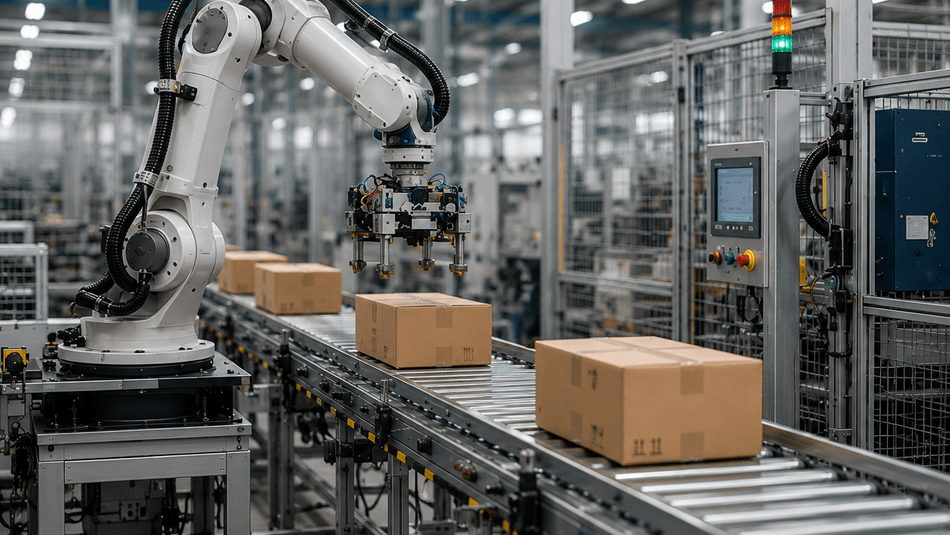
In manufacturing, packaging is often the final stage before storage or shipment, so its efficiency can directly affect the entire production flow. When packaging is too slow, even an efficient production line can start to bottleneck.
Properly selected packaging equipment helps reduce manual handling, standardise results, control material consumption and increase overall process efficiency.
8boxes.lt offers packaging equipment for manufacturing companies – from strapping machines, carton sealing equipment and bag sealing equipment to vacuum packaging, pallet wrappers and labelling solutions.
Packaging automation does not necessarily mean a fully robotic production line.
In most cases, it is practical to start with the process that:
When products are regularly packed into cardboard boxes, manual sealing can become time-consuming.
Carton sealing equipment can help to:
PP strapping is commonly used to secure cardboard boxes and lighter loads.
For lower volumes, manual strapping may be sufficient, but as volumes increase, businesses can move to:
Heavier loads and pallets often require stronger securing.
In these cases, PET strapping can be used together with a manual or battery-powered tool.
A battery-powered PP/PET strapping tool can:
Manufacturing operations often package small products, components, food items or other goods into plastic bags.
Bag sealing equipment can help standardise the sealing process and achieve a more consistent seal.
When choosing equipment, consider:
When a product requires airtight packaging and air removal, vacuum packaging equipment may be suitable.
It can be relevant for:
Shrink packaging is used when a product or group of products is enclosed in heat-shrink film.
These solutions can be useful for:
When finished products are loaded onto pallets, manual stretch wrapping can become slow and inconsistent.
Pallet wrappers can help to:
In manufacturing, labelling is important for both product identification and warehouse or logistics processes.
Label printers can be used for:
There is no need to automate everything at once.
A practical path may look like this:
Stage 1 – optimise the workstation and tools
Improve material layout and use suitable dispensers, holders and hand tools.
Stage 2 – automate individual processes
Automate carton sealing, strapping, bag sealing or pallet wrapping.
Stage 3 – integrate processes
Connect separate machines into a more consistent production and packaging flow.
Stage 4 – move to higher-level automation
When throughput justifies it, consider conveyor systems, automated product feeding, robotic palletising or other individually designed solutions.
A staged approach makes it easier to invest first in the areas where automation provides the greatest practical benefit.
Robotics is generally a higher level of automation and is not necessary for every manufacturing company.
It may be worth considering when:
When evaluating equipment, do not look only at the purchase price.
A useful comparison is:
Current labour cost + packaging materials + downtime + errors + rejects
versus:
Equipment investment + operating cost + remaining operator time + material consumption
A simple payback estimate can be calculated as:
Equipment investment ÷ monthly savings = approximate payback period
It is also worth including additional benefits such as:
Start by observing the current packaging process.
Evaluate:
Depending on the manufacturing process, the packaging flow may look like this:
Product → bag / primary packaging → sealing or vacuum packaging → labelling → cardboard box → carton sealing → PP/PET strapping → pallet → stretch film → warehouse / transport
Not every company needs every stage.
The key is to make sure individual solutions are compatible with each other and match the actual production flow.
At 8boxes.lt, you can find packaging equipment, packaging materials and solutions for different manufacturing and packaging processes.
If you want to automate a manufacturing packaging process, contact 8boxes.lt.
To assess the right solution more accurately, it is useful to provide: