excl VAT
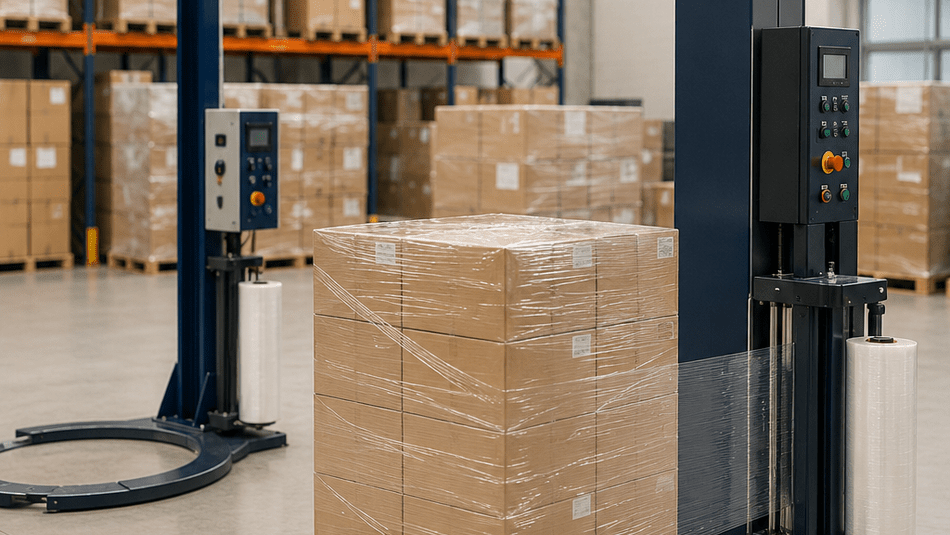
As shipping volumes continue to grow and labor costs increase, more businesses are investing in pallet wrapping equipment. A properly selected pallet wrapper can significantly reduce stretch film consumption, improve load stability, increase packaging efficiency, and lower overall operating costs.
However, not all pallet wrappers are the same. From entry-level semi-automatic machines to fully automated wrapping systems, there are numerous options available on the market. Understanding the differences between them is essential for choosing the right solution for your business.
Many companies still rely on manual pallet wrapping, which often leads to:
A pallet wrapper standardizes the wrapping process, ensuring every load is wrapped consistently while reducing material and labor costs.
Turntable pallet wrappers are the most common and widely used type of pallet wrapping machine.
In this system, the pallet is placed on a rotating platform while the film carriage moves vertically around the load.
For many small and medium-sized businesses, a turntable pallet wrapper is the ideal first step toward packaging automation.
These machines include a top press plate that holds the load securely during the wrapping process.
The additional support prevents lightweight or unstable products from shifting while being wrapped.
One of the most important features when selecting a pallet wrapper is the prestretch system.
Prestretch technology stretches the film before it reaches the pallet, maximizing film efficiency.
Typical characteristics:
Typical characteristics:
A powered prestretch system can reduce stretch film consumption by as much as 40–60%, making it one of the most valuable features for businesses with higher packaging volumes.
Unlike turntable machines, rotary arm wrappers keep the pallet stationary while a rotating arm applies the stretch film around the load.
Rotary arm machines are often preferred when load stability is critical or when wrapping very heavy products.
Automatic pallet wrapping systems require minimal operator involvement.
The operator simply positions the pallet, and the machine completes the entire wrapping cycle automatically.
Common automation features include:
For companies handling large volumes of palletized shipments, automatic systems offer the highest productivity and consistency.
Mobile pallet wrappers travel around the pallet instead of requiring the load to be placed on a rotating platform.
Mobile wrappers are particularly useful when loads are too large, too heavy, or too unstable for traditional turntable systems.
In many cases, manual wrapping or a basic semi-automatic wrapper is sufficient.
Recommended solution:
Recommended solution:
Recommended solution:
Many businesses focus only on the purchase price and overlook long-term operating costs.
Common mistakes include:
The most cost-effective machine is not always the cheapest one—it is the machine that delivers the lowest total packaging cost over time.
A properly selected pallet wrapper can deliver savings through:
Many businesses achieve a return on investment within 12–24 months, especially when upgrading from manual wrapping processes.
Selecting the right pallet wrapper is a strategic decision that affects packaging efficiency, material consumption, labor productivity, and load stability. The ideal solution depends on your pallet volume, product type, growth plans, and operational requirements.
For most small and medium-sized businesses, a semi-automatic turntable pallet wrapper with a prestretch system provides the best balance between investment cost and performance. As packaging volumes increase, rotary arm and fully automatic systems become increasingly attractive options.
By choosing the right pallet wrapping technology today, businesses can significantly reduce packaging costs and improve operational efficiency for years to come.
8BOXES – Engineered Packing Solutions
Professional pallet wrapping, packaging equipment, and packaging materials for warehousing, logistics, manufacturing, and e-commerce businesses.

 Fast Delivery!
 Everything from one source
 Verified quality!
You must login or register in order to make comment!