In logistics and warehouse operations, the main goal is to prepare goods for shipment quickly, secure them reliably and protect them during transport. An efficient packaging process helps reduce labour time, standardise results and minimise unnecessary use of packaging materials.
8boxes.lt offers solutions for warehouses, logistics centres, distribution companies and manufacturing businesses – from stretch films and strapping materials to pallet wrappers, strapping machines and other packaging equipment.
Pallet stabilisation with stretch film
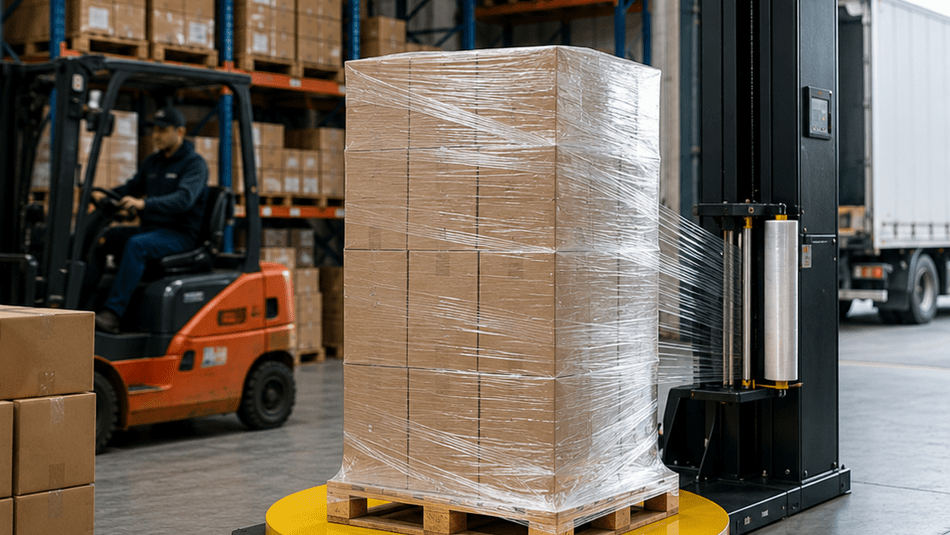
Stretch film is one of the most commonly used solutions for stabilising palletised loads.
It helps to:
- secure the load on the pallet;
- reduce product movement during transport;
- protect goods from dust and moisture;
- combine several boxes into one load;
- reduce the risk of individual packages shifting.
For lower volumes, hand stretch film is usually sufficient, while more intensive operations may benefit from machine stretch film used together with a pallet wrapper.
When is it worth using a pallet wrapper?
When pallets are wrapped regularly, a manual process can become slow and inconsistent.
A pallet wrapper can help to:
- standardise the wrapping process;
- reduce physical strain on employees;
- control film tension more accurately;
- reduce variation between different operators;
- prepare larger numbers of pallets more quickly.
If stretch film consumption is significant, it is worth considering models with a prestretch system, which can help use film more efficiently.
PP and PET strapping
Strapping is used when a load needs additional securing or when stretch film alone is not sufficient.
PP strapping is more commonly used for:
- cardboard boxes;
- lighter loads;
- standard shipments;
- automated carton strapping.
PET strapping is more commonly chosen for:
- heavier pallets;
- industrial loads;
- timber;
- metal products;
- construction materials;
- loads that require more stable tension.
The right strapping should be selected according to load weight, shape, transport conditions and the tool being used.
Manual or battery-powered strapping?
For lower workloads, a manual tool is often sufficient.
A manual PP/PET strapping set can be suitable when strapping is performed only occasionally and a lower initial investment is important.
For more intensive work, a battery-powered PP/PET strapping tool can be more practical because it:
- tensions the strap automatically;
- welds the strap ends;
- helps achieve more consistent results;
- reduces physical workload;
- allows more loads to be strapped in less time.
Corner protectors
Tightly tensioned strapping can damage cardboard box edges or other sensitive surfaces.
Plastic corner protectors help to:
- distribute strap pressure;
- protect load edges;
- reduce the risk of package deformation;
- keep the strap more stable on the load.
They are especially useful for heavier or irregularly shaped loads.
Strapping dispensers and trolleys
If PP or PET strapping is used regularly, it is more convenient to keep the roll on a dedicated dispenser or trolley.
These solutions help to:
- move the roll more easily;
- dispense the strap more conveniently;
- keep the work area organised;
- reduce the risk of roll damage.
This is a simple way to improve ergonomics and reduce unnecessary movement.
Carton sealing
Logistics centres and warehouses often need to prepare large quantities of cardboard boxes.
When manual sealing starts to take too much time, it is worth considering carton sealing equipment.
It can help to:
- speed up box preparation;
- standardise tape consumption;
- achieve more consistent sealing;
- reduce the number of manual actions performed by employees.
The greatest benefit is usually achieved when similar-sized cartons are packed regularly.
Product and shipment labelling
In a warehouse, it is important not only to pack goods properly but also to identify them clearly.
Label printers can be used for:
- shipping labels;
- barcodes;
- warehouse location labels;
- product identification;
- batch marking;
- internal logistics processes.
Clear labelling helps reduce errors and speeds up the movement of goods through the warehouse.
When is it worth automating the packaging process?
Packaging automation does not necessarily mean a fully automated line.
In many cases, it is enough to automate one repetitive process:
- pallet wrapping;
- carton sealing;
- PP strapping;
- PP/PET strap tensioning;
- label printing.
Automation is worth evaluating when:
- packaging takes up a significant amount of employee time;
- shipment volumes are increasing;
- the process becomes a bottleneck;
- different employees produce inconsistent results;
- material consumption is difficult to control;
- physical workload is increasing.
The key is to calculate not only the equipment price but also labour time, materials used and the total cost of preparing one load.
How to choose the right packaging solution?
Before choosing equipment or materials, consider:
- What type of loads will be packed.
- Their weight and dimensions.
- Whether the loads are stable.
- How many loads are prepared per day.
- Whether you pack boxes, pallets or non-standard products.
- Whether strapping, wrapping or both are required.
- How much time packaging currently takes.
- Whether workload is expected to increase in the future.
The more accurately the real process is assessed, the easier it is to choose the right solution and avoid equipment that is either unnecessarily complex or insufficient.
Packaging process from box to pallet
An efficient logistics packaging process may look like this:
Product → cardboard box → sealing → labelling → pallet → stretch film → PP/PET strapping → transport
Not every load requires every stage, but the materials and equipment used should work together as one system.
At 8boxes.lt, you can find packaging materials, strapping materials, stretch films and packaging equipment for different warehouse and logistics processes.
Need help selecting a solution?
If you are looking for a packaging solution for a warehouse, logistics centre or distribution operation, contact 8boxes.lt.
To recommend a suitable solution more accurately, it is useful to provide the load type, dimensions, weight, approximate daily packaging volume and a short description of your current process.