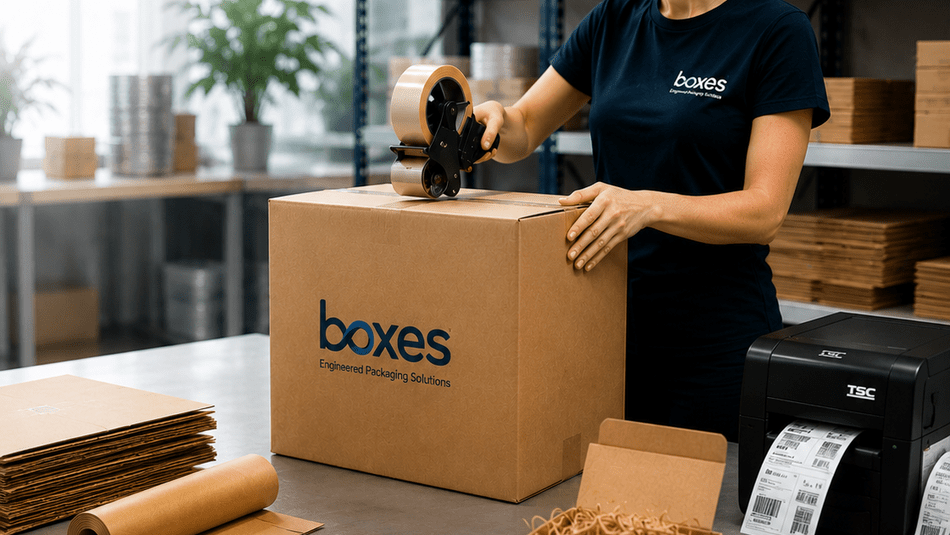
In e-commerce, the packaging process directly affects order preparation speed, shipment protection, transport costs and the customer experience when the parcel arrives. Properly selected packaging, materials and equipment help reduce unnecessary material use, standardise workflows and prepare larger order volumes more efficiently.
8boxes.lt offers packaging materials, cardboard boxes, mailing envelopes, protective packaging materials, packing tapes and packaging equipment for everyday e-commerce order fulfilment.
Choosing the right package size
An oversized box can mean:
- more cardboard;
- more protective void fill;
- more packing tape;
- larger shipment volume;
- higher transport and storage costs.
A package that is too small may fail to protect the product properly or may be difficult to close securely.
For this reason, it is usually better to maintain a limited but well-selected range of commonly used boxes and mailers that covers most real order requirements.
Cardboard boxes for e-commerce shipments
Cardboard boxes are suitable for products that require more rigid transport packaging.
They are commonly used for:
- multi-product orders;
- fragile goods;
- heavier products;
- products requiring additional protective materials;
- larger shipments.
When choosing a box, consider not only its dimensions but also product weight, shape and the stresses it may experience during transport.
When should you use mailing envelopes?
Not every product needs a cardboard box.
Mailing envelopes can be more practical for:
- clothing;
- textiles;
- documents;
- small products;
- less fragile goods.
An envelope usually takes up less space and can reduce package weight and volume.
The key is to assess whether the specific product requires rigid protection against compression or impact.
Protective packaging materials
When a product can move inside the box or is sensitive to impact, protective packaging materials are used.
Their purpose is to:
- fill empty space inside the box;
- reduce product movement;
- protect surfaces;
- absorb part of the impact during transport;
- separate multiple products in one package.
It is important not to use more protective material than necessary. Excessive void fill increases packaging cost and waste without necessarily improving protection proportionally.
Packing tape
Box sealing quality depends not only on the box itself but also on choosing the right packing tape.
When selecting tape, consider:
- box weight;
- cardboard surface;
- storage and transport conditions;
- whether boxes are sealed manually or by machine;
- required tape width.
If a box needs several extra layers simply because the tape does not hold well enough, the cheaper tape may actually become the more expensive option.
Carton sealing equipment
As shipment volumes increase, manual box sealing can become one of the most time-consuming packaging stages.
Carton sealing equipment can help to:
- seal boxes faster;
- standardise results;
- control tape consumption;
- reduce repetitive manual actions;
- increase packing station productivity.
The greatest benefit is usually achieved when large quantities of similar-sized cartons are prepared regularly.
Labels and shipment identification
In an e-commerce warehouse, clear labelling is essential to ensure that the correct parcel reaches the correct customer.
Label printers can be used for:
- shipping labels;
- barcodes;
- product labels;
- warehouse locations;
- internal order numbers;
- return or service labels.
A well-organised label printing process helps reduce manual steps and the risk of errors.
Packaging small products and components
Small products, parts and components can be packed in packaging bags and films.
For example, Zip-lock bags can be useful for:
- small parts;
- fasteners;
- electronic components;
- accessories;
- kit components;
- spare parts.
This makes it easier to group small items and reduces the risk of individual components being lost inside a larger shipment.
Stretch film in warehouse and e-commerce operations
Stretch film is generally used in e-commerce not for individual parcels but for larger loads and internal warehouse operations.
It can be used to:
- bundle several boxes;
- secure pallets;
- protect goods from dust and moisture;
- support internal transport;
- prepare larger orders for shipment.
For lower volumes, hand stretch film is usually sufficient, while businesses that regularly prepare pallets can consider a pallet wrapper.
PP and PET strapping
When boxes or pallets require additional securing, strapping materials can be used.
PP strapping is generally more suitable for:
- cardboard boxes;
- lighter loads;
- standard e-commerce shipments;
- automatic and semi-automatic strapping.
PET strapping is more commonly used for:
- heavier loads;
- pallets;
- industrial or heavier products;
- applications requiring more stable tension.
The selected strap should always be compatible with the strapping tool or machine being used.
When is it worth automating e-commerce packaging?
Automation can become useful when:
- order volumes keep growing;
- employees spend a large part of the day packing;
- shipment preparation starts limiting dispatch speed;
- different employees pack inconsistently;
- too much packaging material is being used;
- repetitive tasks consume too much time.
It is usually unnecessary to automate the entire process at once.
Start by identifying the stage where the most time is lost.
This may be:
- carton sealing;
- label printing;
- strapping;
- pallet wrapping;
- bag sealing.
How to organise an efficient packing station
Even without complex automation, a well-organised packing station can improve productivity.
Frequently used materials should be within easy reach:
- boxes and mailers;
- packing tape;
- labels;
- protective materials;
- cutting and packaging tools;
- waste collection point.
Employees should not need to walk repeatedly between different warehouse areas just to prepare one shipment.
The shorter and more consistent the workflow, the easier it is to increase order preparation throughput.
How to reduce e-commerce packaging costs
Packaging costs should not be optimised simply by searching for the cheapest box.
Consider:
packaging cost + additional materials + employee time + transport cost + risk of damage
Practical steps include:
- Reduce the number of unnecessary box sizes.
- Use packaging that fits the product as closely as practical.
- Avoid excessive void fill.
- Standardise the packaging process.
- Measure employee time per shipment.
- Analyse consumption of frequently used materials.
- Automate the most time-consuming repetitive tasks.
- Regularly review whether the current process is still efficient.
E-commerce packaging process from product to dispatch
Depending on the product, the process may look like this:
Product → inner packaging → protective material → box or mailer → sealing → label → shipment sorting → pallet / courier collection
Larger warehouses may additionally use strapping, pallet wrapping and other automation solutions.
The key is to ensure that every stage protects the product without creating unnecessary material or labour costs.
A complete e-commerce packaging system in one place
At 8boxes.lt, you can find cardboard boxes, mailing envelopes, protective packaging materials, packing tapes, stretch films, strapping materials and packaging equipment.
By properly combining packaging, materials and workflow, businesses can prepare orders faster, use packaging materials more efficiently and reduce the total cost of preparing each shipment.
Need help choosing an e-commerce packaging solution?
If you want to optimise the packaging process for an online store or warehouse, contact 8boxes.lt.
To recommend the right solution more accurately, it is useful to know your average daily shipment volume, most common package sizes, product types and which stage of the packaging process currently takes the most time.