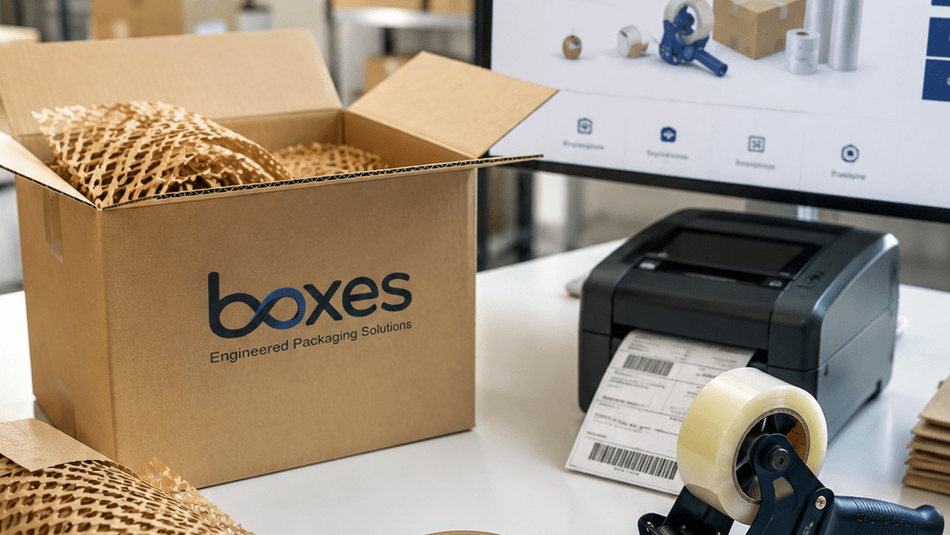
In e-commerce, packaging costs are not limited to boxes, envelopes or packing tape. The total cost of preparing one order is also affected by employee time, the amount of materials used, package size, storage space, transport costs and the risk of damaged shipments.
For this reason, an efficient packaging process should be viewed as a complete system – from selecting the right packaging to preparing the final shipment for transport.
At 8boxes.lt, you can find packaging materials, cardboard boxes, mailing envelopes, stretch films and packaging equipment for more efficient everyday packing.
What makes up the real packaging cost per shipment?
One of the most common mistakes is evaluating packaging cost only by the price of the box, envelope or tape.
The real cost of preparing one shipment may include:
- cardboard box or mailing envelope;
- packing tape;
- protective packaging materials;
- stretch film;
- labels and marking;
- employee labour time;
- storage space;
- the effect of package size on transport cost;
- potential damage, reshipping and return costs.
For this reason, the cheapest packaging material does not necessarily mean the lowest total cost per prepared order.
1. Standardise the packaging you use
Using too many different box and envelope sizes makes warehouse management more complicated and slows down employees.
When many different packaging formats are used:
- more different stock items must be stored;
- more warehouse space is required;
- employees spend longer selecting the right packaging;
- stock levels become harder to control;
- the risk of choosing the wrong packaging increases.
A practical approach is to analyse the most common product and order sizes and choose a limited range of packaging formats that cover most real requirements.
Suitable options can be selected from cardboard boxes and mailing envelopes.
2. Use the right package size
An oversized box means more than just extra cardboard.
It can also increase:
- the need for void fill;
- packing tape consumption;
- final shipment volume;
- storage requirements;
- transport costs.
If a product can be shipped safely in a smaller box or envelope, using a larger package “just in case” usually increases costs unnecessarily.
For smaller and less fragile products, consider mailing envelopes. For more sensitive products, choose an appropriately sized cardboard box with the necessary protection.
3. Avoid overpacking
More packaging materials do not always mean a safer shipment.
Excessive packaging can mean:
- more protective materials;
- more stretch film;
- more packing tape;
- a larger package;
- more employee time;
- more waste.
The goal should be sufficient product protection using an optimal amount of material.
Protective packaging materials should be selected according to product weight, fragility, shape and the actual risks during transport.
4. Review the packaging materials you use
Packaging materials are often selected once and then used for years without checking whether they are still the most suitable option.
It is worth reviewing periodically:
- whether the correct stretch film thickness is being used;
- whether the packing tape is strong enough;
- whether multiple layers of tape are required because the selected tape is unsuitable;
- whether too much protective material is being used;
- whether the strapping material matches the load;
- whether materials are compatible with the packaging equipment in use.
For example, PP strapping is often sufficient for boxes and lighter loads, while PET strapping may be more suitable for heavier loads requiring more stable tension.
5. Reduce employee time per shipment
The time required to pack one shipment can have a greater impact on total cost than saving a few cents by buying cheaper packaging material.
Packing time can be reduced by:
- organising the packing workstation logically;
- keeping frequently used materials within easy reach;
- using suitable dispensers and holders;
- standardising the packing process;
- using correctly sized packaging;
- speeding up label printing;
- using packaging tools suited to the task.
For example, packaging tools can make it easier to use stretch film and other materials and reduce unnecessary employee movements.
6. Automate repetitive tasks
Packaging automation does not necessarily mean a fully robotic line.
In many cases, it is enough to automate one process that consumes the most time.
Depending on the operation, you can automate:
7. Optimise carton sealing
When larger numbers of cardboard boxes are prepared every day, manual sealing can become repetitive and time-consuming.
Carton sealing equipment can help to:
- speed up box preparation;
- achieve more consistent sealing;
- standardise tape consumption;
- reduce the number of manual actions.
The benefits of automation are usually highest when many similar-sized boxes are packed regularly.
8. Choose the right strapping method
When boxes or pallets need additional securing, it is important to choose not only the right strap but also the right way to apply it.
For lower volumes, a manual strapping tool may be sufficient.
For more intensive work, you can use:
9. Optimise pallet wrapping
If an e-commerce warehouse regularly prepares pallets, stretch film consumption can become a significant part of packaging costs.
When wrapping manually, different employees may:
- use different amounts of film;
- apply different levels of tension;
- use a different number of layers;
- stabilise the same load differently.
For higher volumes, it may be worth considering a pallet wrapper.
Models with a prestretch system allow more accurate control of film elongation before it reaches the load and can help use machine stretch film more efficiently.
10. Optimise label printing
In an e-commerce warehouse, efficient and accurate shipment identification is just as important as the packaging itself.
Label printers can be used for:
- shipping labels;
- product labels;
- barcodes;
- warehouse locations;
- internal product identification.
When label printing is organised efficiently, employees need fewer manual steps and the whole order preparation process becomes more consistent.
11. Buy frequently used materials in sensible quantities
If your business regularly uses the same packaging materials, it is worth looking beyond the price of a single roll or pack.
Larger order quantities can help to:
- reduce unit cost;
- reduce purchasing administration;
- reduce delivery frequency and shipping costs;
- lower the risk of unexpectedly running out of essential materials.
However, there is little benefit in holding excessive stock simply because a larger pack has a lower unit price. Real consumption, stock turnover and available storage space should also be considered.
12. Evaluate the total cost per shipment
When comparing different packaging solutions, consider:
Packaging + protective materials + tape + label + employee time + transport + potential damage costs
Only then can two different processes be compared more objectively.
For example, a stronger box may cost more but reduce the need for protective materials and lower the risk of product damage.
Likewise, a more expensive packaging tool may be more economical if it significantly reduces employee time.
When is it worth investing in packaging equipment?
There is no single universal shipment volume at which packaging equipment automatically becomes economically worthwhile.
Investment is worth considering when:
- employees spend a large part of the working day packing;
- shipment or pallet volumes are steadily increasing;
- packaging becomes a process bottleneck;
- maintaining consistent packaging quality becomes difficult;
- large quantities of packaging materials are being consumed;
- physical workload increases;
- higher throughput is needed without increasing labour at the same rate.
The most accurate approach is to calculate the return on investment based on your actual process, comparing equipment cost with potential savings in labour time, materials and other operating costs.
Common mistakes when reducing packaging costs
Choosing only the cheapest material
The lowest unit price does not necessarily mean the lowest total packaging cost.
Using oversized packaging
This can increase void fill, cardboard use, storage requirements and transport costs.
Using too many different packaging formats
This complicates inventory management and employee workflows.
Failing to standardise the process
Different employees may pack the same product differently and use different amounts of material.
Automating too late
If employees spend a large amount of time repeating the same mechanical tasks, it is worth calculating whether partial automation would be more economical.
Where should you start when reducing packaging costs?
Start with a simple analysis:
- Select several of your most common order types.
- Calculate the cost of the packaging materials used.
- Measure employee packing time.
- Evaluate the final shipment size and transport cost.
- Check whether the packaging is larger than necessary.
- Identify which steps can be standardised.
- Determine which repetitive tasks are worth automating.
- Compare the current cost per shipment with the optimised process.
This makes it much easier to identify where the most time and money are actually being lost.
A complete e-commerce packaging system in one place
Efficient e-commerce packaging may include cardboard boxes, mailing envelopes, packing tapes, protective packaging materials, stretch films, strapping materials and packaging equipment.
By properly combining packaging materials, workflow and equipment, you can reduce unnecessary material consumption, shorten packing time and achieve more consistent packaging quality.
Need help optimising your packaging process?
If you want to reduce packaging costs but are not sure where to start, contact 8boxes.lt. We can help assess your current packaging materials and workflow and recommend solutions based on your actual packaging volumes and requirements.