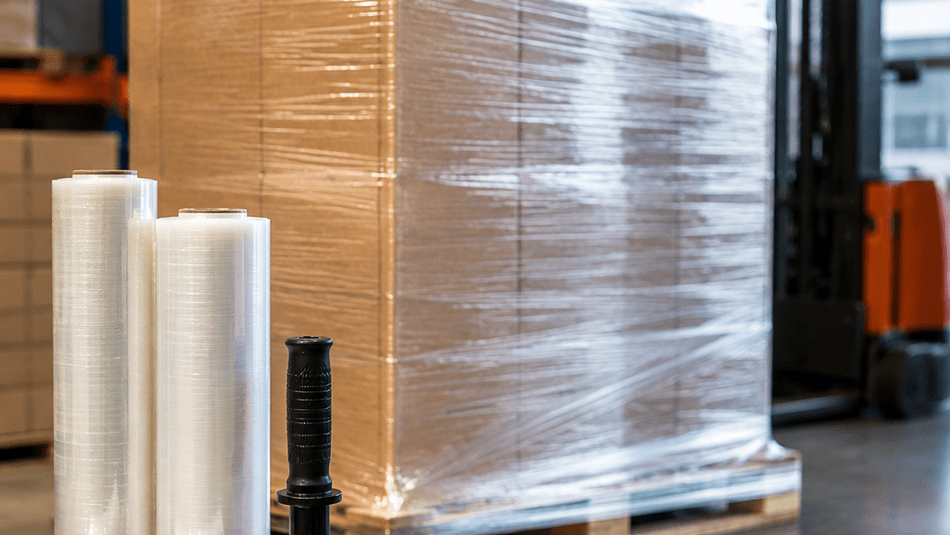
Stretch film is one of the most widely used packaging materials in warehouses, manufacturing, logistics and e-commerce. It is used to secure pallets, stabilise loads and protect goods from dust, moisture and movement during transport.
However, not all stretch films are the same. The right choice depends on the wrapping method, load weight, shape, stability, film thickness, stretch performance and the equipment being used.
At 8boxes.lt, you can find stretch films, pallet wrappers, packaging tools and other packaging equipment.
What is stretch film used for?
The main purpose of stretch film is to secure and stabilise loads.
It is commonly used to:
- wrap pallets;
- bundle several boxes into one load;
- protect products from dust and moisture;
- reduce product movement during transport;
- secure unstable loads;
- protect product surfaces during storage.
When used correctly, stretch film helps keep the load more stable and reduces the risk of goods shifting during transport.
Hand stretch film or machine stretch film?
One of the most important decisions is whether you need hand stretch film or machine stretch film.
Hand stretch film
Hand stretch film is used when pallets or loads are wrapped manually by an employee.
It is suitable for:
- lower packaging volumes;
- warehouses where pallets are wrapped only occasionally;
- loads of different sizes and shapes;
- situations where automated equipment is not required.
Hand stretch film is easier to use with a dedicated stretch film dispenser, which makes film application more convenient and helps reduce physical strain on the operator.
Machine stretch film
Machine stretch film is designed for use with pallet wrappers.
It is generally used when:
- many pallets are wrapped regularly;
- consistent packaging results are important;
- more accurate film tension control is required;
- the aim is to reduce operator influence on the wrapping result;
- prestretch systems are used.
Machine stretch film should be matched to the technical capabilities of the specific pallet wrapper.
What does stretch film thickness mean?
Stretch film thickness is usually measured in microns – µm.
The thicker the film, the more likely it is to:
- resist punctures better;
- suit heavier loads or loads with sharper edges;
- withstand higher mechanical stress.
However, thicker film is not necessarily better for every load.
Using overly thick film on a light and stable pallet can unnecessarily increase packaging costs.
Film thickness should therefore be selected according to the actual load rather than using the principle “the thicker, the better”.
What does film stretch mean?
One of the key properties of stretch film is its ability to stretch.
Stretching can help to:
- wrap more loads from a single roll;
- create the required load containment force;
- reduce film consumption when used correctly.
However, actual performance depends on more than the stated stretch percentage.
It is also affected by:
- film quality;
- film thickness;
- equipment used;
- prestretch system;
- applied tension;
- load shape.
For this reason, two films of the same thickness may consume different amounts of material in real packaging conditions.
What is prestretch film?
Prestretch film is stretched in advance during the manufacturing process.
As a result, it usually requires less physical effort and less additional stretching during use.
Prestretch film can be useful for:
- manual wrapping;
- lighter loads;
- reducing physical strain on employees;
- achieving easier and more consistent wrapping.
It is important not to confuse prestretch film with a pallet wrapper prestretch system.
Prestretch film is the material itself, while a prestretch system is a machine mechanism that stretches the film before it reaches the load.
Clear or black stretch film?
Clear stretch film is the most commonly used option, but black or other opaque film may be more practical in certain situations.
Clear film
Suitable when:
- the load needs to remain visible;
- labels or markings must be readable;
- products need to be identified quickly in the warehouse;
- there is no need to conceal the contents.
Black stretch film
Can be useful when:
- the load contents need to be concealed;
- product visibility should be reduced during transport;
- additional visual separation is useful in the warehouse.
Film colour itself does not indicate strength, so technical specifications should always be evaluated separately.
How to choose stretch film by load type?
Light and stable load
Light pallets with similarly sized cardboard boxes generally do not require very thick film.
Correct wrapping layers and film tension are usually more important.
Heavy load
Heavier pallets require greater load containment force.
In such cases, consider:
- film strength;
- thickness;
- stretch performance;
- number of wrapping layers;
- load stability.
Load with sharp edges
Sharp edges on boxes, metal products or other goods can puncture the film.
Such loads may require:
- more puncture-resistant film;
- thicker film;
- additional corner protection;
- a more suitable wrapping method.
Unstable load
If a load is tall or unstable, simply using more film may not solve the problem.
Consider:
- how goods are arranged on the pallet;
- position of the centre of gravity;
- number of layers;
- reinforcement at the bottom and top of the pallet;
- pallet wrapper settings.
How to choose stretch film by packaging volume?
Low packaging volumes
If pallets are wrapped only occasionally, hand stretch film is usually the most practical choice.
Regular packaging
When pallets are wrapped every day, consider not only the film price but also employee time and physical workload.
High packaging volumes
For higher volumes, it is worth considering a pallet wrapper and machine stretch film.
An automated process allows better control of film consumption and delivers more consistent results.
Why is cost per pallet more important than cost per roll?
One of the most common mistakes when comparing stretch films is looking only at the price of the roll.
A more useful calculation is:
Film cost ÷ number of pallets actually wrapped = film cost per pallet
A cheaper roll does not necessarily mean lower packaging costs if:
- the film stretches poorly;
- more layers are required;
- it tears more often;
- more material is used per pallet.
For businesses wrapping larger volumes, it is often worth testing several films under real operating conditions.
How can stretch film consumption be reduced?
Reducing film consumption is not only about choosing a thinner film.
More effective approaches include:
- using film that matches the load;
- applying the correct tension;
- avoiding unnecessary overwrapping;
- standardising the number of wrapping layers;
- using suitable dispensers;
- regularly checking wrapping settings;
- using a pallet wrapper for higher volumes;
- evaluating a prestretch system.
The goal is not to use as little film as possible, but to use the minimum amount that still provides the required load stability.
Manual wrapping or pallet wrapper?
Manual wrapping is usually suitable for lower volumes.
Its advantages include:
- low initial investment;
- flexibility;
- ability to wrap loads of different shapes.
However, as packaging volumes increase, several disadvantages become more noticeable:
- higher physical workload;
- inconsistent tension;
- different film consumption between employees;
- more difficult process standardisation.
A pallet wrapper can automate part of the process and provide better control over packaging parameters.
Mini stretch film
Mini stretch film is used for smaller products and packages where a standard wide roll is not practical.
It is suitable for:
- bundling small components;
- securing long products;
- small boxes;
- profiles;
- pipes;
- protecting various individual items.
Mini stretch film is easiest to use with a dedicated holder.
Common mistakes when choosing stretch film
Choosing only by thickness
Thicker film does not automatically mean a more economical or better solution.
Choosing only by roll price
Real cost per pallet is more important.
Using the same film for every load
A light pallet of boxes and a heavy, unstable industrial load may require different solutions.
Using too many layers
More layers do not necessarily improve load stability proportionally.
Incorrect tension
Too little tension may fail to stabilise the load sufficiently, while too much tension may deform boxes or tear the film.
How to compare two stretch films
To compare different films objectively:
- Choose the same type of load.
- Record the pallet size and weight.
- Use the same wrapping method.
- Measure the amount of film used.
- Check load stability.
- Check whether the film tears.
- Calculate the actual film cost per pallet.
This allows you to compare real economic performance rather than theoretical specifications alone.
Stretch film and the complete pallet packaging system
Efficient pallet packaging often involves more than stretch film alone.
Depending on the load, you may also use:
Need help choosing stretch film?
If you are unsure which stretch film is right for your application, contact 8boxes.lt.
To recommend a more suitable option, it is useful to know:
- whether the film will be used manually or with a pallet wrapper;
- load type;
- pallet weight and height;
- whether the load is stable;
- the film you currently use;
- approximate film consumption.
With this information, it is easier to choose a practical solution and assess whether film consumption can be reduced.